REVIEW · SINGAPORE
Singapore – Albatross Speedboat Adventures Cruising in Sentosa
Book on Viator →Operated by Tall Ship Royal Albatross · Bookable on Viator
Fast water rewrites your view of Singapore, with a high-speed Sentosa run and island history narration from the water. I like how the timing is tight: 60 minutes gives you a full dose of views without chewing up a whole day. The one thing to double-check is that the cruise is not recommended for people over 130 kg, elderly travelers, or expectant mothers.
What I also really like is the on-the-spot help: the crew is friendly, they’ll even take your group photo, and you get a small kit with water plus rain gear and wipes. The trade-off is simple: you’re riding and looking, not doing an on-island hangout, so it’s best if you want motion, scenery, and stories more than beach time.
In This Review
- Key things to know before you go
- Royal Albatross Speedboat: fast thrills without a huge time drain
- Price and time value for a 60-minute Sentosa circuit
- Where you start at Sentosa and what to bring
- Life jacket rules and who should avoid the cruise
- What you see from the water: Sentosa plus the southern islands
- Long Ya Men: the Dragon’s Tooth Gate and why it matters
- Lazarus Island: white sand, a quiet lagoon, and prison-era shadows
- Kusu Island: tortoise-named pilgrimage island with Chinese and Malay shrines
- Saint John’s Island: Raffles’ 1819 anchorage and the cholera quarantine era
- Sisters Islands: Minah, Linah, and a pirate storm legend
- Tekukor Island: special permission, giant clams, and “turtle dove” meaning
- Onboard feel: friendly crew, photo help, and a break from heat
- Who this is for (and who should skip it)
- Should you book Albatross Speedboat Adventures in Sentosa?
- FAQ
- FAQ
- How long is the speedboat cruise around Sentosa?
- How much does the tour cost per person?
- Where do we meet for the cruise?
- Is the activity round-trip to the same meeting point?
- What’s included in the ticket price?
- Are alcoholic beverages included?
- What do children need to do on board?
- Is the cruise suitable for everyone by weight or health?
- How many people are on the boat?
Key things to know before you go
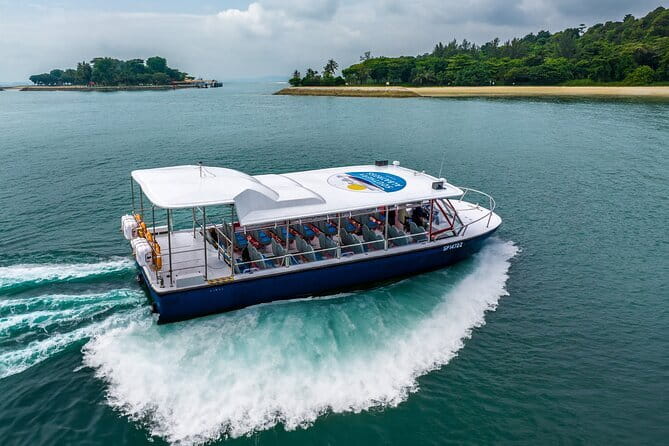
- Royal Albatross takes you around Sentosa and the southern islands in about 60 minutes
- City skyline views from port waters give you a different Singapore angle fast
- Stop-by-stop storytelling covers places like Long Ya Men and St John’s Island
- You get bottled water and a small on-board kit (raincoat and wipes are mentioned)
- Crew is helpful and friendly, including photo help
- The boat caps at 50 travelers, so it doesn’t feel like a cattle drive
Royal Albatross Speedboat: fast thrills without a huge time drain
This is the kind of Singapore outing that fits into almost any plan. You meet at S.E.A. Aquarium (8 Sentosa Gateway), hop aboard the Tall Ship Royal Albatross, and in about an hour you’re back where you started. No long transfers, no half-day logistics spiral.
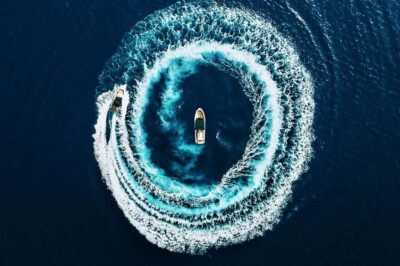
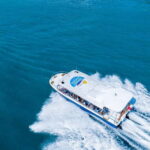
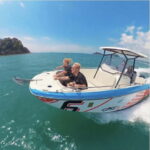
The pace is the point. You’ll get that high-speed feeling as the boat runs across the waves, then you switch gears to scenery and narration as you pass the southern islands. It’s a fun balance: adrenaline up front, then brain-on with the island history behind the scenery.
Price and time value for a 60-minute Sentosa circuit
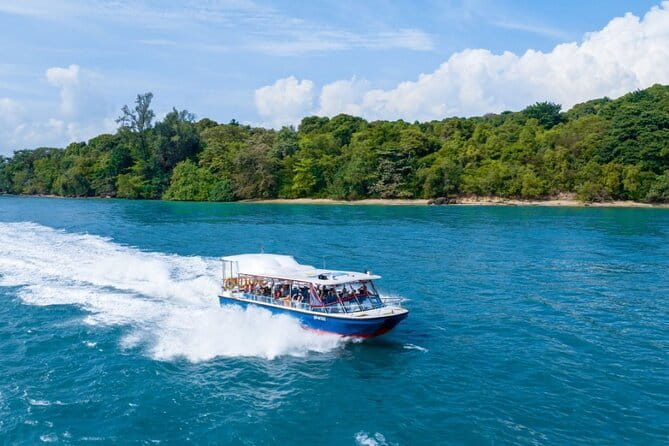
At $35.85 per person, this is priced like an activity you add for variety, not a full-day anchor. The big value move is that all fees and taxes are included, plus bottled water, and the dockside admission is covered under terms.
You’re also buying time efficiency. Many visitors spend hours trying to line up waterfront views, photos, and “what am I looking at?” moments. Here, the view comes with a running explanation of the places you’re seeing, and the whole thing stays to roughly one hour.
One more practical point: this tour is non-refundable and cannot be changed, so don’t book it if your schedule might be a moving target.
Where you start at Sentosa and what to bring
Meet at S.E.A. Aquarium, 8 Sentosa Gateway, Sentosa Island, Singapore 098269. The activity ends back at the meeting point, so you’re not figuring out a new end location after you get off the boat. There’s also a ticket redemption point at the same place, which keeps things straightforward.
Bring whatever helps you handle wind and sea spray. Even if you don’t feel you need it, the crew provides a small kit, and rain gear is specifically mentioned in the feedback. If you’re sensitive to motion, consider planning your ride when you feel rested and not overly full.
Life jacket rules and who should avoid the cruise
The boat crew has clear safety rules. Children under 8 must sit in the middle row between adults, wear the provided life jacket, and have parents sign a waiver. Children 8 to 12 are also recommended to sit in the middle row between adults, with supervision at 1 adult to 2 children at all times.
It’s also not recommended for people over 130 kg (286 pounds), elderly individuals, and expectant mothers. If any of those apply, it’s worth choosing a different Sentosa plan that matches your comfort and safety needs.
What you see from the water: Sentosa plus the southern islands
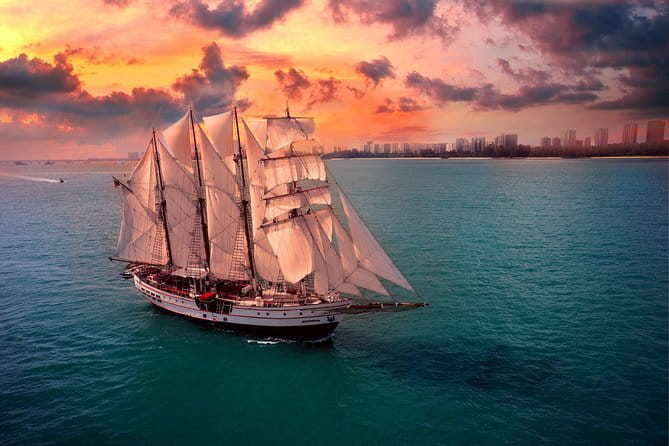
Sentosa is the busy end of the story. From the sea, it reads as a cluster of beaches, attractions, and skyline energy—think Siloso and Tanjong beaches, Universal Studios Singapore, and the general “destination island” vibe. Even if you don’t spend time onshore, the boat view helps you place Sentosa in context.
Then the route shifts from the “activity island” feel to the quieter southern islands. This is where the narration adds meaning: those islands are described as places with beaches, biodiversity, and pilgrimage sites—not just dots on a map.
A key thing to remember is that this is a cruise. You’re looking from the water during the hour, so if your main goal is getting off and exploring on foot, you’ll want to pair this with a separate island visit later.
Long Ya Men: the Dragon’s Tooth Gate and why it matters
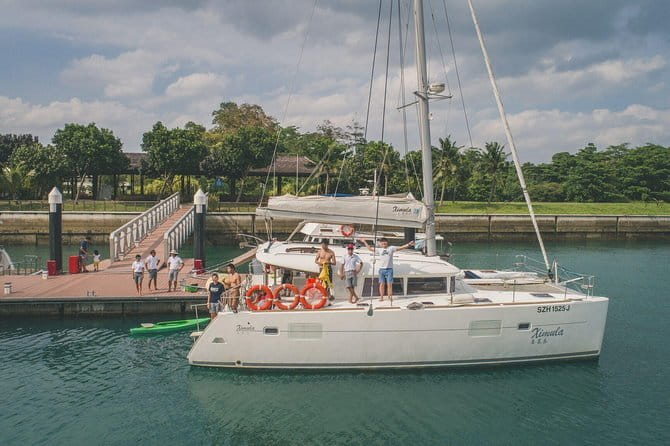
One of the more intriguing stops is Long Ya Men, often translated as Dragon’s Tooth Gate in Chinese. The story ties it to historical travel accounts and references the old Singapore strait and surrounding waters, including Blakang Mati.
The narration links the dragon teeth idea to physical rock formations—described as Batu Belayar sail rock (now replicated at Labrador Park) and a related promontory near Fort Siloso. You’ll also hear about changes over time: high ground removed during British fort construction, and the demolition of Batu Belayar by colonial authorities to improve navigation around Keppel Harbor.
For you, this kind of explanation is more than trivia. It turns the shoreline into a “map with reasons,” so photos don’t feel like random postcards—you start to understand what the sea corridor demanded from ships, forts, and ports.
Lazarus Island: white sand, a quiet lagoon, and prison-era shadows
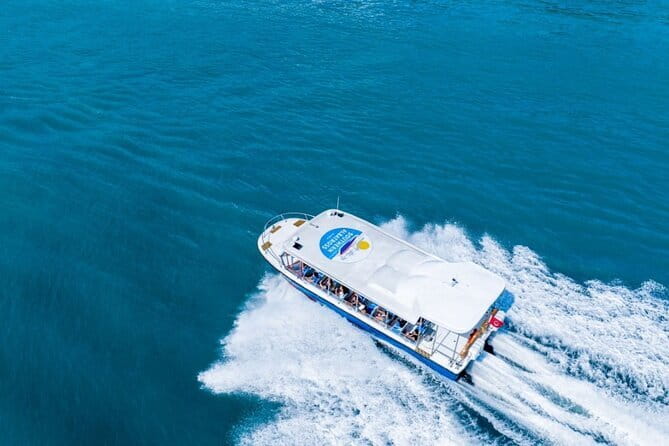
Lazarus Island (once called Pulau Sakijang Pelepah, meaning island of a deer and palms) gets a heavier backstory. In the late 19th century, it housed prison confinement sheds, and it’s also tied to a later abandonment after a daring escape.
Today, the focus is on the beach. You’ll learn it has clean white sandy shores around a C-shaped lagoon, and it’s framed as one of Singapore’s best-kept secrets. The island is also described as one of the few southern spots where private yachts and boats can anchor, which is a nice detail if you love the idea of quiet “off the main island” water time.
The trade-off? This is still a boat cruise, so you don’t get to treat Lazarus like a full beach day. You’re getting the perspective—then deciding if you want to come back later for a slower pace.
Kusu Island: tortoise-named pilgrimage island with Chinese and Malay shrines
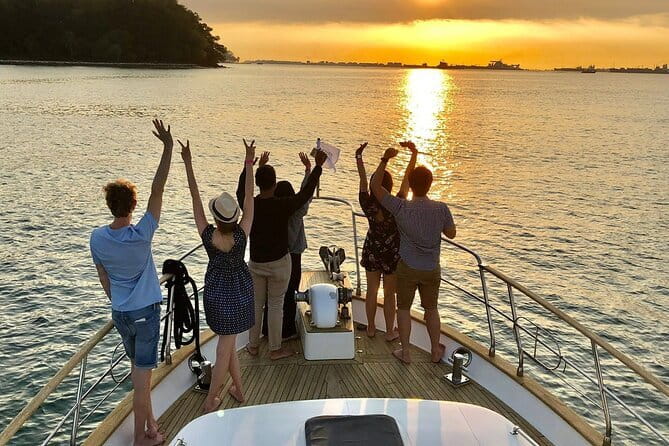
Kusu Island is where the cruise narration turns spiritual. It’s home to a Chinese temple plus three Malay keramat (shrines), and thousands of pilgrims are described as visiting each year—especially during the ninth lunar month between September and October.
You’ll also hear the name meaning: Kusu is said to be “tortoise” or “turtle” in the Hokkien dialect. The island is also referenced with other names and older designations, including Pulau Tambakul, Goa Island, and Peak Island.
What makes this stop useful for you is the way it connects people to place. A small island might look like just another shoreline from a distance—until the story of temples, quarantine deaths, and burial sites gives it weight and context.
Saint John’s Island: Raffles’ 1819 anchorage and the cholera quarantine era
St John’s Island is one of the most dramatic historical stops you’ll hear about on this route. It’s described as a penal settlement that later became a holiday resort, but the key scenes are 19th-century.
One headline detail: Stamford Raffles anchored off the island on 28 January 1819 before heading to mainland Singapore. Later, during an immigrant influx, the island is described as serving as a report boat station for the marine department.
Then comes the cholera chapter. In 1873, a cholera epidemic is said to have caused 448 deaths. The island later hosted a floating police station, a hospital, and a quarantine burial ground at Peak Island, handling over 1300 cholera-infected Chinese coolies. After immigration slowed, it housed political detainees and secret society ringleaders, then it was converted into a drug rehabilitation center, and in 1975 it became a popular holiday camp site for schools and students.
This is exactly the kind of “place names with consequences” story that makes the water route feel worth it. You’re not just seeing coastline—you’re seeing how Singapore’s sea access shaped public health, law enforcement, and settlement patterns.
Sisters Islands: Minah, Linah, and a pirate storm legend
South of Singapore, the cruise includes the Sisters Islands: Pulau Subar Darat (Little Sister’s Island) and Pulau Subar Laut (Big Sister’s Island). The islands are small—1.7 hectares and 3.9 hectares—but the legend makes them feel bigger than their size.
The story goes like this: two sisters, Minah and Linah, were so close they vowed to marry two brothers so they could stay together. Suitors came, but the brothers never arrived. Then a pirate chief tried to force Linah into marriage, and in their attempt to escape, the sisters drowned in a storm. The islands emerged where they perished, and villagers named them Sisters Islands in memory.
Even if you’re not a folklore person, this kind of myth gives you an emotional map. When you look at the shoreline later, you’ll remember that someone once explained these waters with a story—because that’s what humans have always done along the sea.
Tekukor Island: special permission, giant clams, and “turtle dove” meaning
Tekukor Island (also called Pulau Tekukor) sits just off Sentosa and is described as rarely visited due to the need for special permission. Recently, special authorization was secured to search for giant clams, and the island is also described as having served as an ammunition dump until the 1980s.
The environment is also worth noting. It’s described as expansive, with rocky cliffs, a lengthier intertidal zone on one side, and reefs around the perimeter. The name “Tekukor” is said to translate to “turtle dove” or “spotted neck dove,” which gives you a different way to imagine the island beyond its human past.
If you’re the type who likes photos that feel a bit more meaningful than just good light, this stop helps. It’s a reminder that even places you can’t easily visit still shape the coastal story.
Onboard feel: friendly crew, photo help, and a break from heat
This cruise is designed to be comfortable enough for a short, action-forward outing. The boat operates with a maximum of 50 travelers, which helps keep the experience from feeling crowded in the way some city attractions do.
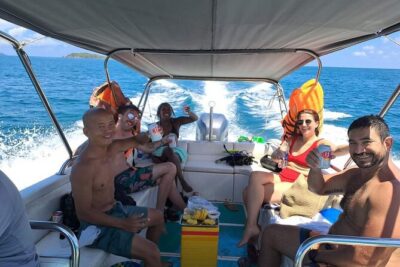
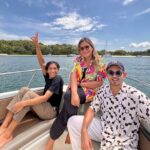
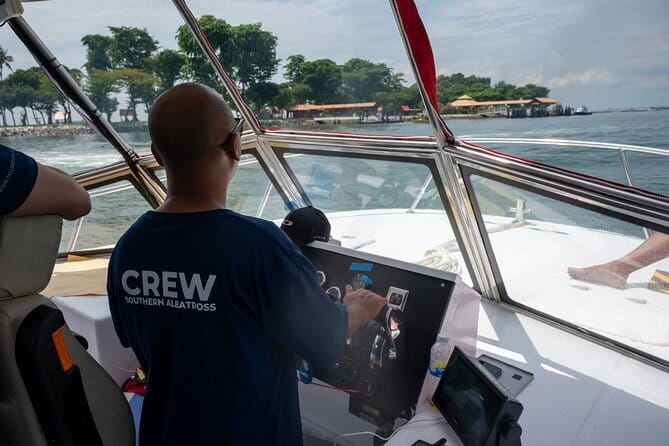
The crew is a big part of the value. Feedback highlights staff who are very friendly and helpful, including taking pictures for you. People also describe getting a small bag with water, a raincoat, and wipes, which is the kind of practical touch that matters when you’re in sea wind and tropical weather.
And there’s a surprisingly useful perk: it’s also a way to escape the heat for an hour. Even when the day is hot and sticky, the speedboat motion and airflow can feel like a reset.
Who this is for (and who should skip it)
This tour fits best if you want three things in one shot: water views, brief thrills, and stories that make the coastline feel less generic.
You’ll likely enjoy it if you’re:
- doing a first visit to Singapore and want an easy “see it all” water angle
- traveling with a mix of ages who still enjoy action for a short time
- a photo person who wants skyline and island shapes from the same route
You should skip or choose something else if you’re in any of the non-recommended groups: over 130 kg, elderly individuals, or expectant mothers. And if kids are coming along, follow the seating and life jacket rules so everyone stays aligned with the crew’s safety plan.
Should you book Albatross Speedboat Adventures in Sentosa?
Book it if you want a high-impact Singapore experience that lasts only about an hour, includes water and essential fees, and gives you island context you can’t get from looking at a map. The best argument is the mix: speedboat fun plus the kind of place-based narration that turns the route into something you remember.
Don’t book it if you need a calm, onshore sightseeing day with long stops. This is a time-efficient cruise designed for viewing from the sea, not extended island exploration.
Finally, be smart about timing. Because the purchase is non-refundable and not changeable, lock it in only when you’re confident your day is stable.
FAQ
FAQ
How long is the speedboat cruise around Sentosa?
It’s approximately 1 hour.
How much does the tour cost per person?
The price is $35.85 per person.
Where do we meet for the cruise?
You meet at S.E.A. Aquarium, 8 Sentosa Gateway, Sentosa Island, Singapore 098269.
Is the activity round-trip to the same meeting point?
Yes, it ends back at the meeting point.
What’s included in the ticket price?
The ticket includes all fees and taxes, bottled water, and Royal Albatross dockside admission (subject to terms).
Are alcoholic beverages included?
No, alcoholic beverages are not included.
What do children need to do on board?
Children under 8 must sit in the middle row between adults, wear the provided life jacket, and parents must sign a waiver. Children between 8 and 12 are recommended to sit in the middle row and must be supervised with a ratio of at least 1 adult to 2 children at all times.
Is the cruise suitable for everyone by weight or health?
It is not recommended for individuals over 130 kilograms (286 pounds), elderly individuals, or expectant mothers.
How many people are on the boat?
The cruise has a maximum of 50 travelers.